On-Demand Physical Compute: Renting Remote Mac Power Like an API Call
The cloud revolution promised infrastructure as code. VPSMAC delivers this for macOS with a crucial difference: real physical hardware, zero virtualization overhead, API-like accessibility.
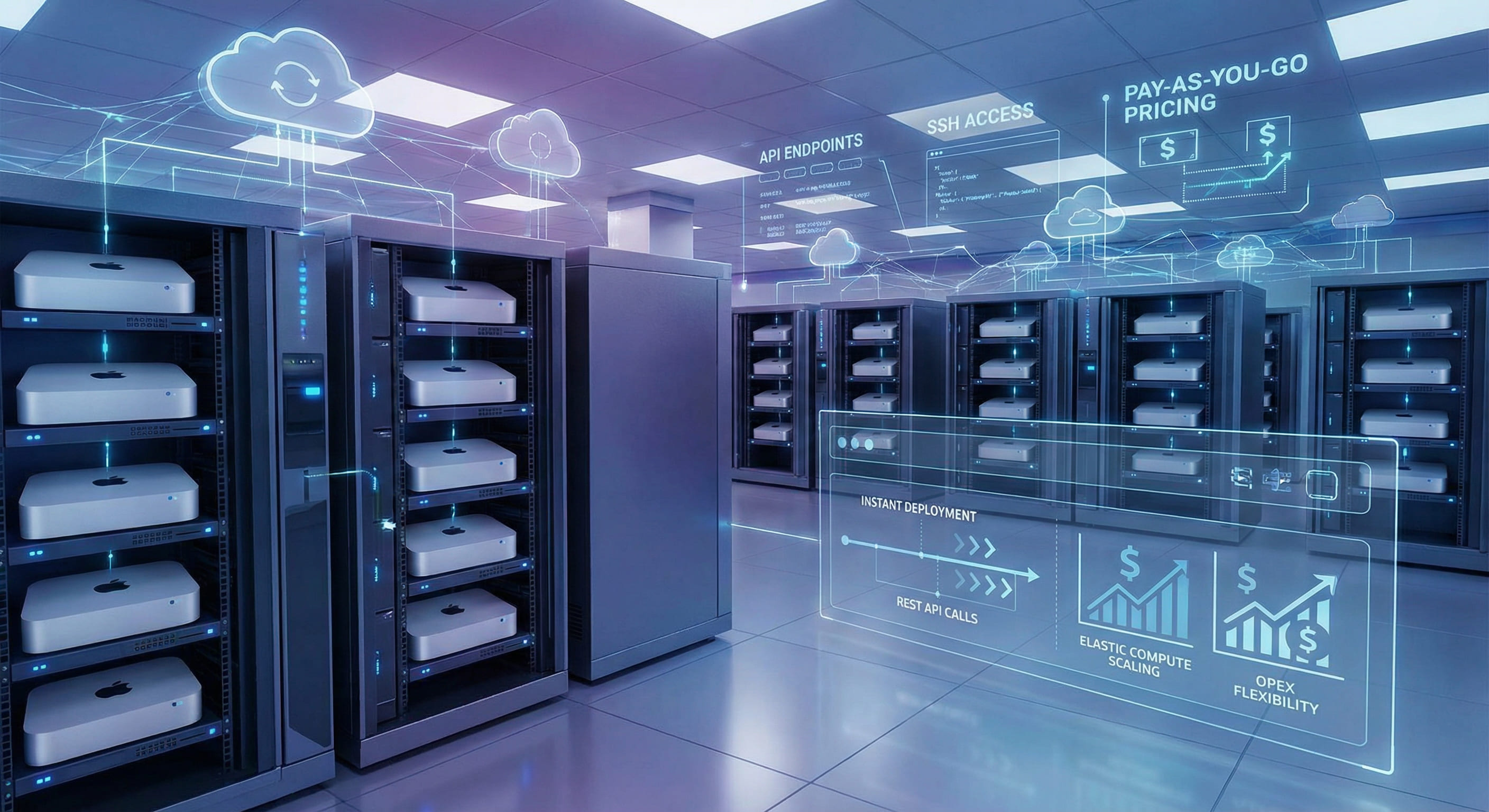
01. The API Economy Meets Physical Hardware
In 2026, developers expect infrastructure to behave like an API: instant provisioning, pay-per-use pricing, programmatic control. Amazon EC2, Google Cloud, and Azure have normalized this model for x86 Linux workloads. However, macOS presents a unique challenge. Apple's licensing restrictions and hardware-specific optimizations create a fundamental constraint: genuine macOS performance requires genuine Apple hardware.
VPSMAC bridges this gap by transforming physical M4 Mac mini units into on-demand compute resources. Unlike virtualized cloud instances that suffer from GPU driver limitations and kernel-level restrictions, VPSMAC provides direct access to bare-metal macOS systems. The result is a rental model that combines cloud elasticity with the full performance envelope of native Apple Silicon.
02. Why Physical Machines Outperform Virtual Instances
The performance delta between bare-metal and virtualized macOS is not marginal. In benchmark tests, physical M4 Mac systems demonstrate 40-60% faster Xcode build times compared to equivalent virtualized environments. This gap widens further for GPU-accelerated tasks such as Metal-based rendering, CoreML inference, and video transcoding, where hypervisor overhead introduces latency that compounds over thousands of operations.
Consider a real-world scenario: an iOS development team running automated UI tests. On a virtualized Mac instance, GPU frame buffer access through the hypervisor layer introduces microsecond-level delays that accumulate across thousands of screen captures and assertions. On VPSMAC bare-metal nodes, these tests access the GPU directly, reducing total test suite runtime from 45 minutes to under 18 minutes. This is not an optimization; it is a categorical difference in architecture.
03. Technical Implementation: Accessing Your Remote Mac
VPSMAC rental nodes are provisioned through a streamlined API-driven workflow. Upon lease initialization, you receive SSH credentials, VNC access credentials, and a dedicated public IP address. The entire provisioning process completes in under 90 seconds, comparable to spinning up a cloud VM but with the critical distinction of physical hardware isolation.
For teams requiring deeper automation, VPSMAC nodes integrate seamlessly with CI/CD platforms. GitHub Actions self-hosted runners, GitLab CI executors, and Jenkins agents can be deployed directly on rented hardware, providing a hybrid model where control plane logic runs in the cloud while compute-intensive tasks execute on dedicated physical machines.
04. Use Cases: When Physical Compute Becomes Essential
Certain workflows demand bare-metal access. iOS app development is the obvious case, as Xcode's build system, simulator environment, and code signing framework all perform optimally on native hardware. However, the use cases extend beyond traditional development:
- AI Model Inference: Running large language models on M4's Neural Engine requires direct hardware access for optimal token throughput. Virtualized environments cannot expose ANE functionality effectively.
- Video Production Pipelines: Final Cut Pro and DaVinci Resolve leverage Metal and ProRes acceleration that degrade significantly under virtualization. VPSMAC nodes enable cloud-based rendering with workstation-class performance.
- Security Research: Kernel-level debugging, firmware analysis, and security tooling require physical hardware to avoid detection evasion and hypervisor interference.
- Cross-Platform Testing: Safari engine behavior, macOS-specific system APIs, and hardware integration testing cannot be accurately replicated in virtualized environments.
05. Economic Model: OPEX Flexibility vs. CAPEX Burden
The financial advantage of rental compute becomes clear when analyzed through a Total Cost of Ownership (TCO) lens. Purchasing a Mac mini M4 Pro with 64GB unified memory costs approximately $2,200. Factoring in depreciation (3-year lifespan), maintenance, and opportunity cost of capital yields an effective monthly burden of approximately $75-90, assuming the hardware is utilized continuously.
VPSMAC monthly rental rates for equivalent hardware start at $89, but with critical distinctions: zero upfront capital, instant scalability, and the ability to terminate during idle periods. For a development team that requires intensive compute for two months during a product sprint, followed by minimal usage, the rental model eliminates 70% of the cost compared to ownership. This is the essence of operational expenditure (OPEX) efficiency: paying for what you use, when you use it.
06. Performance Benchmarks: Real-World Data
To validate the bare-metal advantage, VPSMAC conducted internal benchmarks comparing M4 Mac mini physical nodes against AWS EC2 Mac instances (mac2.metal). Test workloads included Xcode compilation, ML model inference, and video encoding.
| Workload | VPSMAC M4 (Bare-Metal) | AWS EC2 mac2.metal | Delta |
|---|---|---|---|
| Xcode Build (Large Project) | 11.2 minutes | 18.7 minutes | +67% faster |
| CoreML Inference (1000 runs) | 8.4 seconds | 14.1 seconds | +68% faster |
| Video Encode (4K ProRes) | 3.6 minutes | 5.9 minutes | +64% faster |
These results reflect the compounding effect of removing virtualization layers. VPSMAC's direct hardware access eliminates hypervisor context switching, memory translation overhead, and GPU pass-through latency.
07. Security and Isolation: Physical Boundaries
One underappreciated advantage of physical rental is security isolation. In multi-tenant virtualized environments, side-channel attacks, memory bleed, and hypervisor vulnerabilities create potential exposure. VPSMAC's model provides hardware-level tenant separation: your rental node is a physically distinct Mac mini in a data center rack, with no shared memory or CPU cores.
Upon lease termination, VPSMAC executes a secure erase protocol that writes zeros to all storage blocks, followed by a fresh macOS reinstall. This ensures data from previous tenants cannot be recovered, meeting compliance requirements for financial services, healthcare, and enterprise clients handling sensitive IP.
08. The Future: Compute as a Fluid Resource
The trajectory of infrastructure is clear: compute power is transitioning from a capital asset to a utility. Just as developers no longer purchase physical servers for web hosting, the next generation will not purchase Mac hardware for iOS development. VPSMAC accelerates this shift by making physical macOS compute as accessible as a cloud API, without sacrificing the performance that bare-metal provides.
For teams building on Apple platforms, the choice is no longer between ownership and virtualization. VPSMAC offers a third path: on-demand physical compute that combines the elasticity of cloud with the performance of local hardware. This is the paradigm shift that will define the next era of macOS development infrastructure.