2026년 OpenClaw는 Docker, npm, 소스 중 무엇으로 배포해야 할까? Mac 클라우드 장기 운영 비교
By 2026, OpenClaw is no longer just something teams install once for a quick demo. It often becomes part of message routing, automation chains, gateway services, and long-running AI operations. This article compares Docker, npm, and source-based deployment on a Mac cloud host from the perspective that actually matters: upgrades, logging, rollback, SSH maintenance, and stable 24/7 runtime behavior.
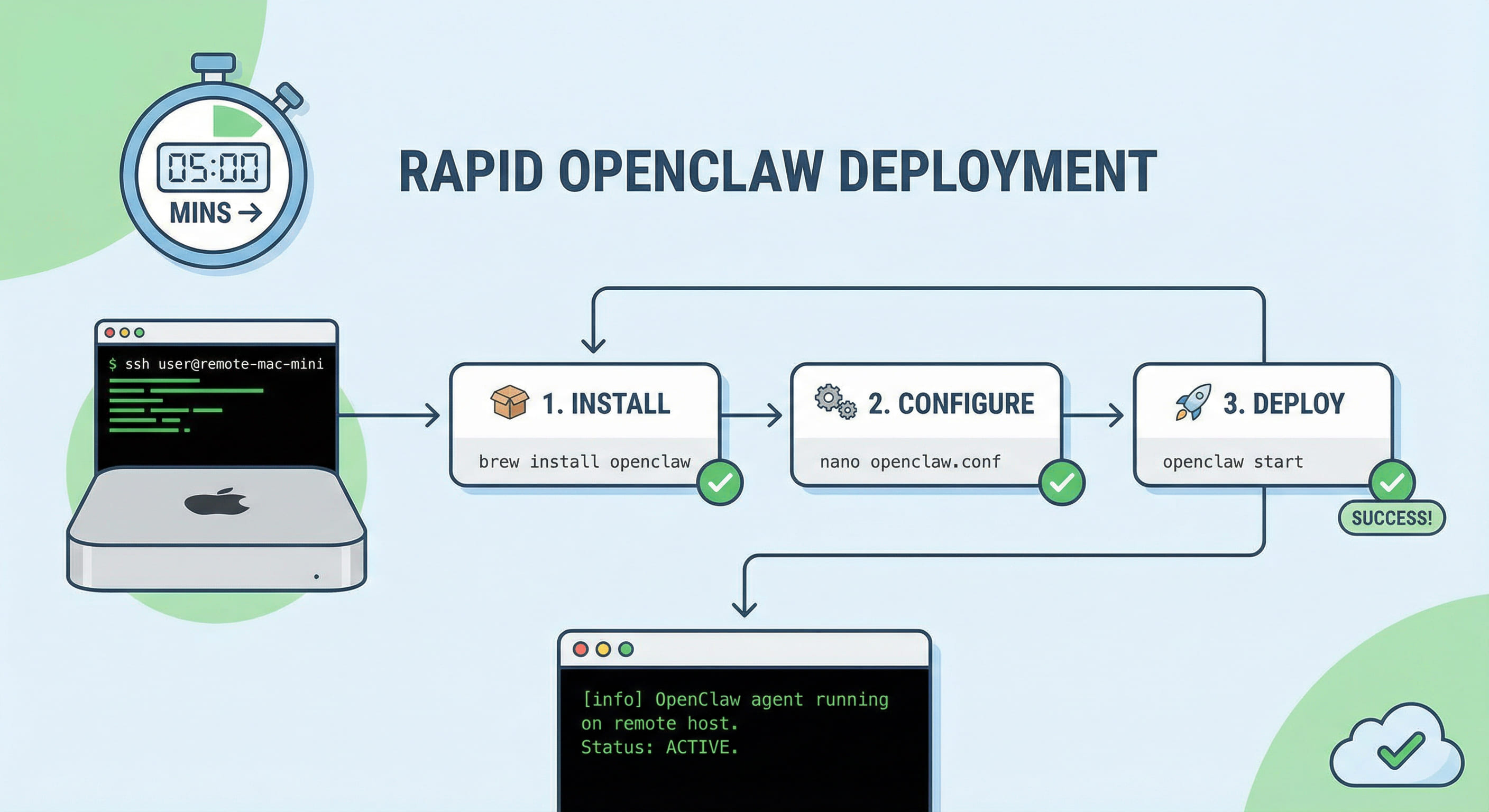
In this guide
- 1. Why installation speed is not the real deployment decision
- 2. Decision matrix: Docker vs npm vs source
- 3. Why Mac cloud hosts fit long-running OpenClaw workloads
- 4. A 5-step plan for stable production deployment
- 5. Upgrade, logging, rollback, and team operations
- 6. FAQ and the final recommendation
1. Why getting OpenClaw installed is not the same as running it well
Many OpenClaw tutorials optimize for a quick first install, but production reality is shaped by very different questions: how cleanly can you upgrade, where do logs go, how do you restart safely, and how fast can someone else on the team understand the runtime layout. If those questions are postponed, even the fastest install path becomes an operational liability within days.
For teams that already think in VPS terms, the real advantage of a Mac cloud host is not just access to macOS. It is the ability to combine Apple tooling, OpenClaw runtime requirements, SSH administration, and durable process management on a single controllable node. That shifts the evaluation from 'what installs fastest' to 'what stays understandable and recoverable after the first week'.
2. Decision matrix: when Docker, npm, or source is the right fit
Use this matrix to decide based on long-term operations rather than first-run convenience.
| Method | Best fit | Long-term maintenance | Upgrade & rollback | Recommendation |
|---|---|---|---|---|
| Docker | Teams with image discipline and strong environment isolation needs | Medium to high | Clear image history but extra macOS container overhead | Best when container operations already exist |
| npm | Operators who want simple CLI/gateway management over SSH | Lowest | Straightforward updates and visible filesystem layout | Best default for most single-node long-running setups |
| Source | Teams that patch, debug, or customize OpenClaw deeply | Highest | Maximum flexibility with maximum version discipline | Choose only when source-level control is required |
3. Why a Mac cloud host fits long-running OpenClaw operations
OpenClaw's official macOS setup documentation explicitly calls for Node.js 22+, pnpm, and Xcode 26.2+ for source-oriented workflows. That is a strong sign that once your deployment moves beyond a toy install, macOS becomes a natural home for higher-control OpenClaw operations.
A Mac cloud host is especially useful when you need to keep SSH-based operations, launchd-managed background jobs, optional GUI troubleshooting, Apple-specific toolchains, and stable gateway behavior in one place. That makes it easier to maintain OpenClaw as a long-running service instead of a fragile, one-off experiment.
4. A 5-step plan for stable production deployment
If the goal is stable long-running service rather than a quick demo, use this 5-step plan:
- Define the target first: single-user gateway, shared team node, or source-level customization. The right install path depends on that answer.
- Establish SSH visibility and version baselines: verify Node.js 22+, pnpm, Xcode 26.2+, PATH, logs, and disk space before choosing a method.
- Default to npm for single-node production if simplicity, gateway visibility, and CLI maintenance matter most.
- Choose Docker only when image discipline and isolation clearly outweigh extra macOS container overhead; choose source only when code-level control is necessary.
- Before handoff, wire in launchd, restart behavior, logs, upgrade notes, and rollback procedure regardless of method.
This command set gives you a simple baseline: visible CLI install path, visible gateway state, visible source workflow, and a macOS-native launchd model for long-running jobs.
5. Upgrade, logging, rollback, and collaboration advice
These concrete facts belong in your deployment checklist:
- OpenClaw's macOS developer setup requires Node.js 22+ and pnpm, with Xcode 26.2+ needed for source build workflows.
- For durable macOS background processes, launchd is the right operational model rather than reusing Linux service assumptions.
- If the gateway gets stuck on 'Starting...', the official troubleshooting path is to inspect `openclaw gateway status`, stop it, and verify whether port 18789 is still held by another process.
- If your main priority is maintainable day-2 operations, npm usually beats source deployment. If your main priority is image-level consistency, Docker gains ground.
Operationally, this means your choice should also map to who will own upgrades. If the answer is an infra-minded operator working over SSH, npm usually wins. If the answer is a platform team standardizing images, Docker becomes more attractive. If the answer is an engineering team modifying behavior directly, source deployment is justified.
6. FAQ and the final recommendation
FAQ
When is npm the best choice?
npm is usually the right default when you want to run an OpenClaw gateway on a single Mac cloud host, manage it over SSH, keep CLI paths simple, and pair it with launchd for long-running service behavior.
Is Docker a bad option on a Mac cloud host?
Not necessarily. Docker still makes sense for teams with established image workflows and environment isolation rules. The trade-off is extra macOS container overhead and a more layered troubleshooting path.
When should I choose source deployment?
Choose source when you need to patch OpenClaw, debug the build, track upstream changes closely, or deeply customize the macOS app and CLI behavior.